Project Alpha: Credit, capital, and a small project that fits the moment

A quiet week ending Apr 30
This week’s activity was limited to a single filing: a six-lot rural subdivision at 7022 Barnhartvale Road in Kamloops.
On its own, the project is modest. But placed in the current credit and market environment, it provides a useful reference point for how development strategies are adjusting in 2026.
Market context: uneven recovery
The broader British Columbia housing market remains in a soft phase. Total home sales are expected to decline slightly in 2026, while inventory levels are at their highest point in years.
This softness is not uniform across regions.
The Lower Mainland continues to face elevated supply and weaker buyer activity. In contrast, Interior markets are showing more resilience. Kamloops recorded 202 residential sales in March, representing a 9.2% increase year-over-year and a 33% increase from February.
The divergence is summarized below:
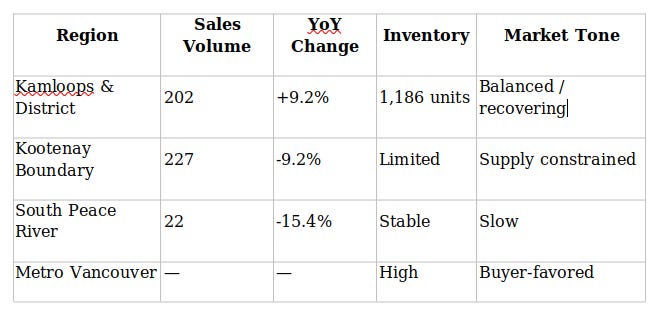
The result is a market whe
Credit conditions: stable, but selective
Monetary conditions have stabilized. Interest rates are expected to hold around current levels through 2026, with inflation largely contained and economic growth modest.
This has improved predictability, but not risk appetite.
Lender behaviour remains clearly segmented:
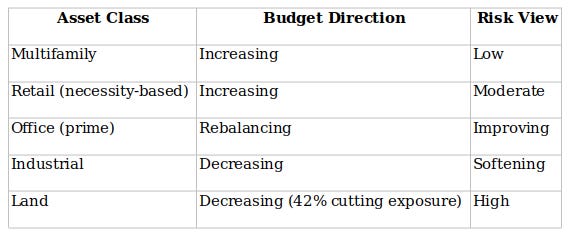
Land development stands out. It is the only asset class where lenders are broadly reducing exposure.
This has direct implications for what types of projects move forward.
Project overview: 7022 Barnhartvale Road
The subject project is a fee-simple subdivision consisting of six rural residential lots on approximately 30 acres.
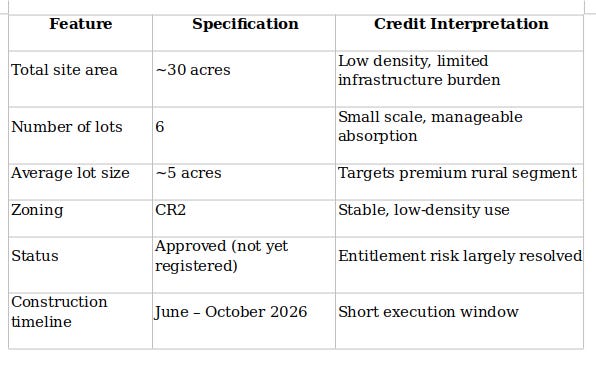
The project is single-phase and does not involve vertical construction. Delivery is limited to subdivision completion.
Capital structure: notable simplicity
The financing profile is the defining feature.
The project is fully self-funded. There is no construction loan, no external lender, and no financing conditions tied to sales.
This removes several common sources of execution risk:
no lender approval risk
no presale financing thresholds
no priority conflicts within the capital stack
In the current environment, this level of simplicity is increasingly uncommon.
Risk allocation
While the project presents low execution risk at the developer level, the underlying risks are not eliminated.
They are transferred.
Purchasers assume responsibility for:
well drilling and water quality
septic system installation and approvals
home construction
fire protection requirements in the absence of hydrants
This is typical for rural subdivisions, where infrastructure and build risk sit with the end user rather than the developer.
Local market: Barnhartvale
Barnhartvale is a low-density, lifestyle-oriented submarket within Kamloops.
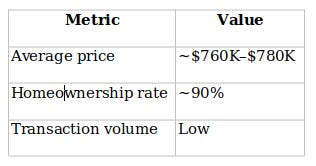
Demand is driven less by short-term turnover and more by long-term occupancy. Buyers are typically seeking space, privacy, and flexibility rather than proximity to the urban core.
Capital markets: deployment returning, but uneven
Lenders are re-entering the market in 2026, with a majority planning to increase origination volumes.
However, this capital is not evenly distributed.
Private lenders, particularly Mortgage Investment Corporations (MICs), continue to fill gaps:
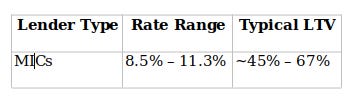
For land-related financing, equity requirements remain high, often in the 35%–50% range.
Policy backdrop
Policy changes are adding incremental cost pressure.
From October 2026, Provincial Sales Tax will apply to a range of professional services, including accounting, engineering, and property management.
At the same time, zoning reforms are encouraging higher density in urban areas, which may gradually reduce the availability of large-lot rural land.
Conclusion
This week’s filing is small, but it aligns closely with current market conditions.
The combination of:
reduced lender appetite for land
stable but cautious credit conditions
higher execution risk for large projects
is pushing development toward simpler structures.
The Barnhartvale project reflects that shift. It minimizes reliance on external capital, limits execution complexity, and focuses on a niche but stable segment of demand.
In this market, simplicity is not a constraint.
It is becoming a requirement.